Can An AI Receptionist Help Your HVAC Business Grow?
Last July, a single broken AC unit in Phoenix generated 47 phone calls to HVAC companies in one afternoon. Only 11 of those companies picked up. The other 36? Those callers moved on to the next search result before the voicemail greeting even finished playing.
An AI receptionist for HVAC businesses exists to fix exactly this problem. It answers every call your team can't get to, books service appointments, captures lead details, and routes emergencies to the right person. All while your technicians are elbow-deep in ductwork two stories up.
Marcus owns a mid-size HVAC company in Houston. Twelve technicians, two office staff, and a reputation that's taken 15 years to build. Last summer, he asked his office manager to track every call that went to voicemail for a month. The number was 127.
His average service ticket runs $420. Even if a quarter of those callers would've booked, that's over $13,000 in lost revenue in a single month. During the busiest season of the year.
Marcus isn't bad at running his business. He's just facing a math problem that every HVAC company hits eventually: more calls come in than humans can handle, especially when the temperature spikes. And unlike a restaurant or retail store, HVAC work is urgent. Nobody's casually browsing for a furnace repair. When they call, they need help now.
What does a missed call really cost an HVAC company?
More than you'd think, and the number compounds fast.
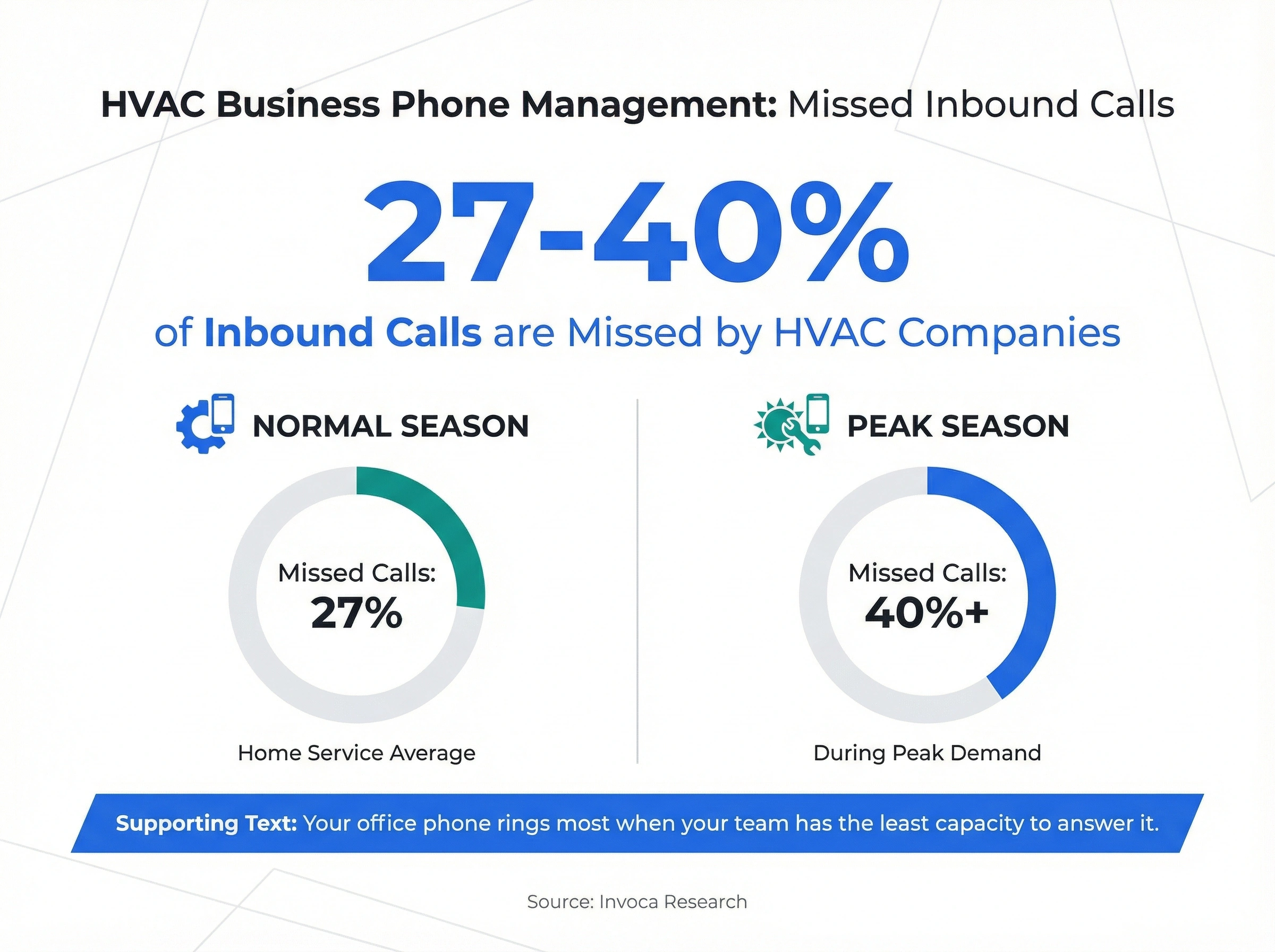
According to Invoca research, home service businesses miss roughly 27% of all inbound calls. For HVAC companies during peak season, that number climbs well past 40%. Your office phone rings most when your team has the least capacity to answer it.
Here's where it gets expensive. According to HouseCallPro data, 78% of customers hire the first service company that answers the phone. Not the cheapest. Not the one with the best reviews. The first one that picks up. Speed of response beats everything else.
Now layer in HVAC-specific economics:
| HVAC service type | Avg. ticket value | Missed calls/week (peak) | Est. monthly loss |
|---|---|---|---|
| Residential AC repair | $300-$600 | 15-25 | $4,500-$15,000 |
| Furnace install/replace | $3,000-$8,000 | 5-10 | $15,000-$80,000 |
| Commercial HVAC service | $1,500-$5,000 | 5-15 | $7,500-$75,000 |
| Duct cleaning/inspection | $300-$500 | 8-15 | $2,400-$7,500 |
| Maintenance contracts | $150-$300/year | 10-20 | $1,500-$6,000 |
The maintenance contracts row is sneaky. Each missed call doesn't just lose a one-time service fee. It loses the lifetime value of a recurring customer who'd call you first every time their system acts up. One lost maintenance contract can mean $5,000-$10,000 in revenue over five years.
And roughly 80% of callers won't bother leaving a voicemail. They hang up and call the next name on Google. By the time you check your missed calls at lunch, those leads are already scheduled with your competitor.
What happens to those calls when your whole crew is out on jobs?
They disappear. And each one takes potential revenue with it.
Why are HVAC businesses harder to staff than other trades?
The HVAC industry has a staffing problem that goes beyond just finding good technicians. The nature of the work creates a unique set of challenges for phone coverage that most other trades don't face at the same scale.
Seasonal demand swings are extreme. When a heat wave hits, your call volume can triple overnight. When temperatures are mild in spring or fall, it drops to a trickle. Hiring a full-time receptionist at $37,000 a year makes sense during July and January. In October? That person is sitting idle.
This is the fundamental challenge. You need full phone coverage during your busiest months but can't justify the overhead during the slow ones. A part-time hire helps, but good luck finding someone willing to work 60 hours a week in August and 10 hours in April.
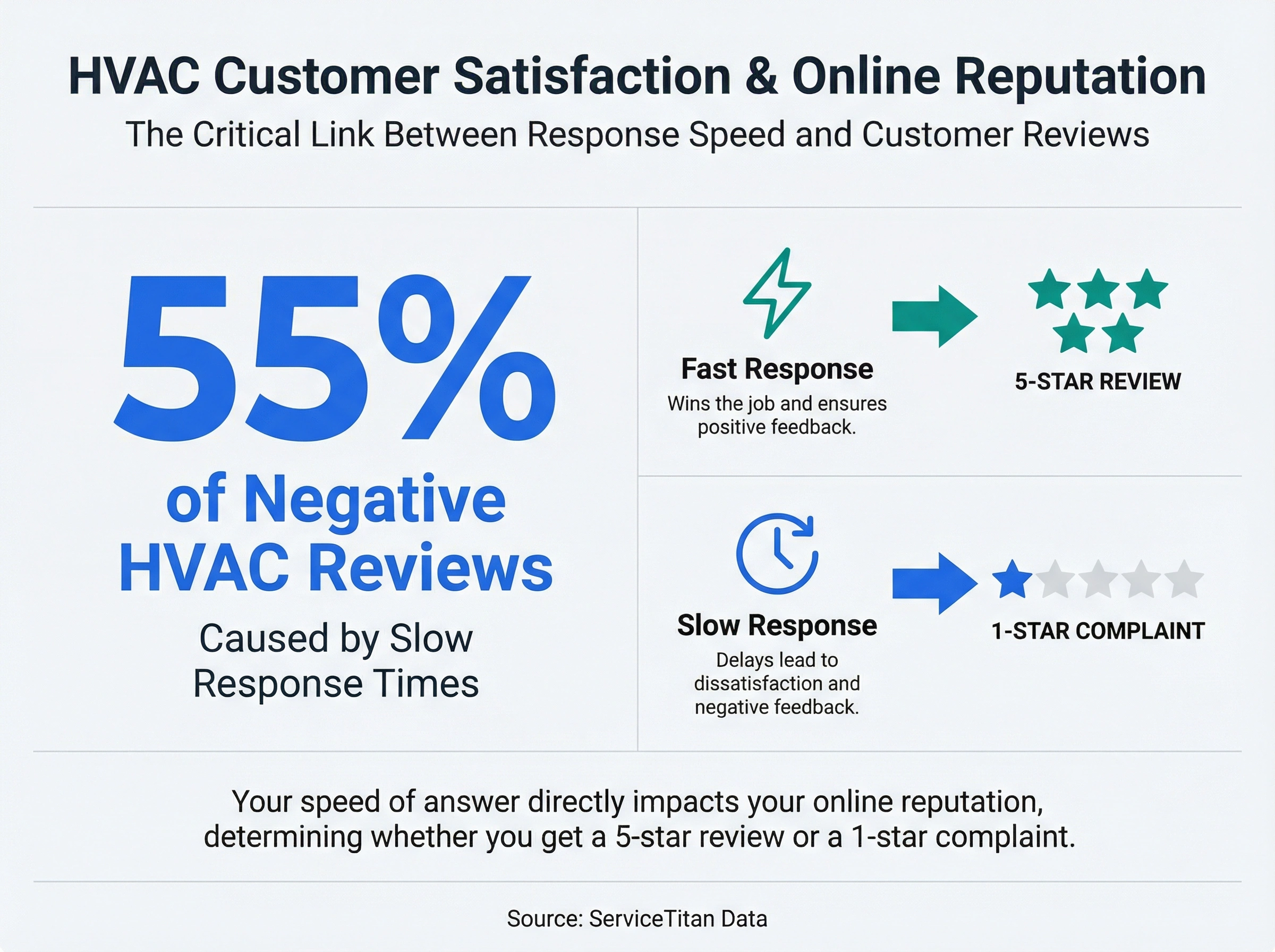
Every call is time-sensitive. A homeowner whose AC dies on a 102-degree afternoon isn't comparison shopping. They're calling the first three companies on Google and going with whoever answers. According to ServiceTitan data, delays are the driving factor behind 55% of negative HVAC reviews. Your speed of response doesn't just win the job, it determines whether you get a 5-star review or a 1-star complaint.
Your techs can't answer phones. An electrician might be able to take a quick call between tasks. But an HVAC technician who's brazing refrigerant lines, working in a tight attic crawl space, or standing on a rooftop in direct sun? That phone stays in the truck. The work demands both hands and full attention.
Dual-system complexity means longer calls. HVAC covers heating and cooling, residential and commercial, installation and repair. A caller might need a furnace tune-up, an AC replacement, duct sealing, or a full commercial system overhaul.
Each requires different questions, different scheduling, and different technician skill sets. Your receptionist needs to know which questions to ask for each one. That's a lot of training for a role with high turnover.
So what's the answer? Hire more office staff?
You could. But here's my honest take after watching businesses across a dozen industries try to solve the phone problem: throwing bodies at it doesn't scale. You'll always be either overstaffed during slow months or underwater during peak season. The smarter play is a system that flexes with your call volume automatically.
What can an AI receptionist handle for HVAC companies?
An AI receptionist answers your HVAC business phone 24/7. It's not a phone tree or a voicemail system. It's a conversational AI that handles real calls the way a trained office person would.
Here's what it actually does, broken down by call type:
Emergency service calls
A homeowner's furnace dies at 11 PM in January. They call your number in a panic. The AI picks up on the first ring, identifies the situation as urgent (no heat, elderly resident, frozen pipes risk), collects the address and callback number, and immediately routes the call to your on-call technician's cell phone. The tech gets a text summary with all the details before they even answer.
New service requests
Someone's AC is making a weird noise. They call at 2 PM on a Tuesday. The AI greets them by your company name, asks what's going on, gathers the system type (central air, mini-split, heat pump), age of the unit, and the symptoms. Then it checks your schedule and books a diagnostic visit. The caller gets a text confirmation. You get a notification with the full details.
Maintenance and tune-up scheduling
A homeowner wants to schedule their annual furnace check before winter. The AI handles the entire booking, confirms the appointment, and sends reminders. No human involvement required.
Existing customer follow-ups
A client calls to ask when their replacement parts will arrive, or whether Tuesday's install is still on schedule. The AI provides the update based on the info in your system, or offers to have someone call back with specifics.
Commercial property calls
A facility manager calls about HVAC maintenance for a three-building office complex. The AI qualifies the inquiry, captures the property details, square footage, number of units, and current service provider, then flags it as a high-value commercial lead for your attention.
After-hours inquiries
It's 8:30 PM on a Wednesday. A homeowner just moved into a new house and wants to know about setting up a maintenance plan. They don't want to wait until morning. The AI handles the full conversation, explains your service plans, and books a consultation for the next business day.
Here's how it all breaks down:
| Call type | What the AI does | Your involvement |
|---|---|---|
| Emergency (no heat/AC) | Identifies urgency, routes to on-call tech | Take the callback |
| New service request | Qualifies, books appointment | Review summary |
| Maintenance scheduling | Books and confirms | None needed |
| Existing customer check-in | Provides update or books callback | Only if complex |
| Commercial inquiry | Qualifies, captures details | Follow up on lead |
| After-hours booking | Full service, books next-day | Review next morning |
| Spam/solicitation | Declines politely | Never bothered |
The key difference from a traditional answering service? An HVAC answering service run by humans has limited hours, takes messages, and charges per minute. An AI receptionist handles the full conversation, books the appointment, and gives you a clean summary. It's the difference between a sticky note that says "someone called about their AC" and a complete service ticket ready for dispatch.
Before vs. after: how call handling changes with AI
The easiest way to see the impact is to compare a typical peak-season week with and without an AI receptionist. Let's use a mid-size HVAC company running 8-12 technicians.
Without AI receptionist
| Metric | Typical week (July) |
|---|---|
| Total inbound calls | 120-150 |
| Calls answered | 60-80 (40-55%) |
| Calls to voicemail | 50-70 |
| Voicemails actually left | 10-15 (80% hang up) |
| After-hours calls missed | 25-35 |
| Emergency calls missed | 3-5 |
| Callbacks made | 8-12 (next day) |
| Jobs booked from calls | 35-45 |
| Estimated revenue captured | $14,000-$27,000 |
With AI receptionist
| Metric | Typical week (July) |
|---|---|
| Total inbound calls | 120-150 |
| Calls answered | 120-150 (100%) |
| Calls to voicemail | 0 |
| Voicemails actually left | N/A |
| After-hours calls answered | 25-35 (all of them) |
| Emergency calls routed instantly | 3-5 (all of them) |
| Appointments booked automatically | 50-70 |
| Jobs booked from calls | 65-90 |
| Estimated revenue captured | $26,000-$54,000 |
That's roughly double the revenue captured from the same number of inbound calls. The calls were coming in either way. The only difference is whether someone answered them.
Honestly, the jury's still out on whether AI handles complex multi-system diagnostics as well as a seasoned dispatcher who's been in HVAC for 20 years. For those tricky calls where a customer is describing symptoms that could be three different problems, a human expert still has the edge. But those calls represent maybe 5-10% of your total volume. The other 90% are routine requests that the AI handles faster and more consistently than any office staff.
There's a ripple effect here that's easy to overlook. When you answer every call, your online reviews improve. Responsiveness is one of the top factors in HVAC reviews. According to ServiceTitan data, delays are behind 55% of negative HVAC reviews. When every caller gets a friendly, immediate response, even if it's an AI, your 5-star review count climbs. And better reviews mean more inbound calls, which creates a growth loop that compounds quarter over quarter.
Your marketing ROI improves too. Think about it: you're paying for Google Ads, SEO, truck wraps, yard signs, and direct mail. All of that spend funnels into one action, a phone call. If nobody picks up that call, every marketing dollar was wasted. An AI receptionist is the piece that makes sure the leads you're already paying for actually convert into booked jobs.
And here's something most HVAC owners don't think about: the data. When every call is answered and summarized, you start seeing patterns. Which zip codes generate the most emergency calls. What time of day your highest-value leads call. Which services get the most inquiries.
Which marketing channels drive the most after-hours calls. That kind of data is invisible when half your calls go to voicemail. But once you can see it, you can make smarter decisions about where to focus your crew, your ad spend, and your expansion plans.
Is an AI receptionist worth it for a small HVAC company?
But does the math actually hold up for a smaller shop?
Let's break it down for a 3-person HVAC company: one owner-technician and two employees.
Current costs of handling calls yourself:
You're answering the phone between jobs, during lunch, and while driving. Your spouse helps when they can. You miss about 8-12 calls a week during peak season. At an average ticket of $350, with 30% conversion, that's $840-$1,260 per week in lost revenue, or roughly $3,400-$5,000 per month during summer.
Cost of a human receptionist:
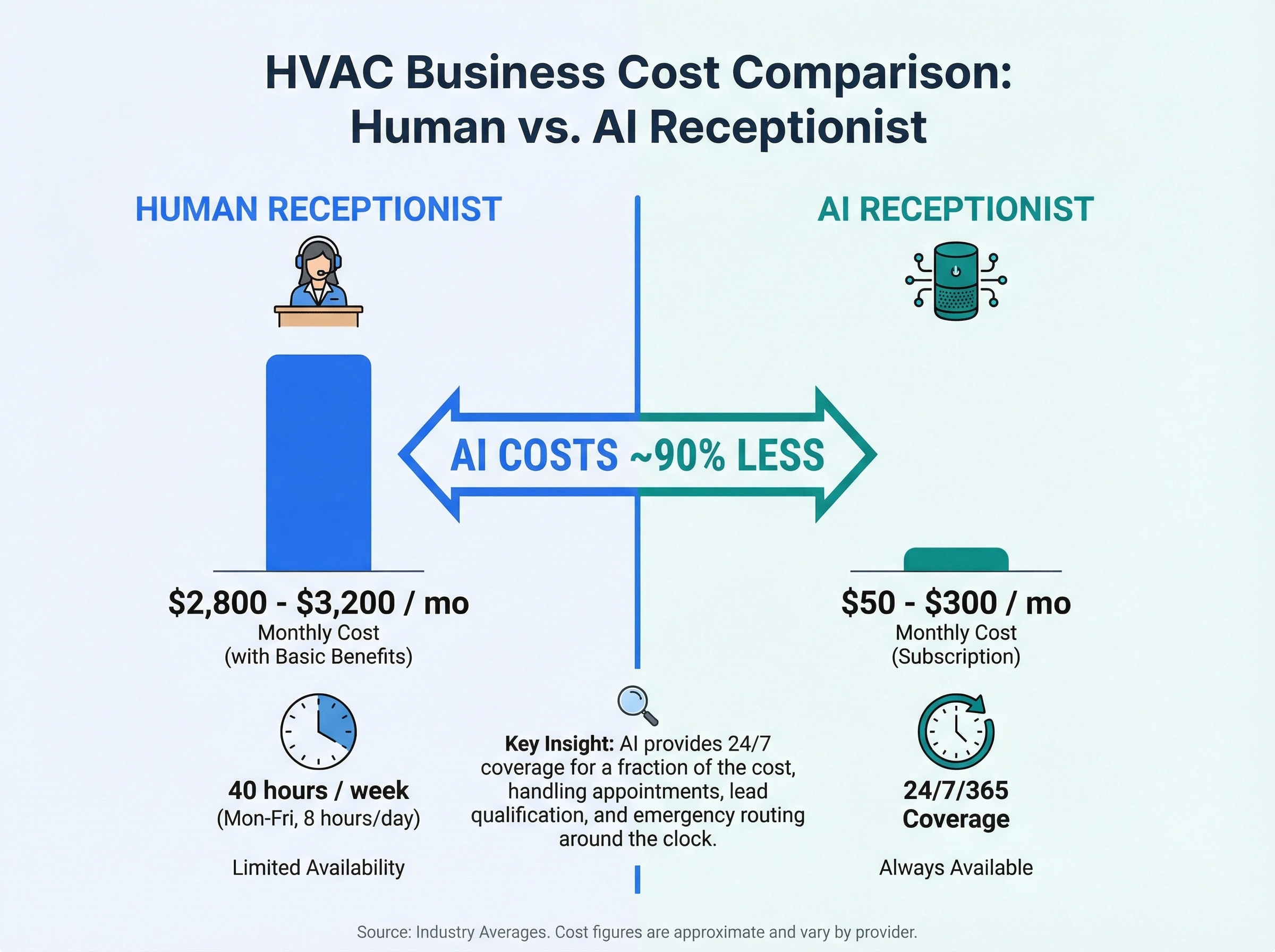
A full-time receptionist runs $2,800-$3,200 per month with basic benefits. They work 8 hours a day, 5 days a week. Your calls don't stop at 5 PM, and they definitely don't stop on weekends. Plus you're paying that salary year-round, even during the slow months when your phone barely rings.
Cost of a traditional answering service:
A human-based HVAC answering service charges $200-$500 per month for basic message-taking. They take a message and email it to you. They don't book appointments, they don't qualify leads, and they don't know the difference between a condenser and a compressor.
Cost of an AI receptionist:
$50-$300 per month. Works 24/7, 365 days a year. Books appointments, qualifies leads, routes emergencies, and gives you organized call summaries. Scales with your call volume without scaling your costs.
Here's the side-by-side:
| Option | Monthly cost | Hours covered | Books appointments | Knows HVAC | Scales with demand |
|---|---|---|---|---|---|
| DIY (yourself) | $0 (but lost revenue) | When available | No | Yes | No |
| Full-time receptionist | $2,800-$3,200 | 40 hrs/week | Yes | With training | No |
| Traditional answering service | $200-$500 | 24/7 | No | No | Partially |
| AI receptionist | $50-$300 | 24/7 | Yes | Yes (trained) | Yes |
Skip the traditional answering service entirely. They're a middleman that creates more work, not less. You still have to call every lead back, figure out what they need, and book the appointment yourself. You're paying someone to take notes you could've gotten from a voicemail.
The AI receptionist is the only option that actually removes work from your plate while capturing more revenue. For a small HVAC company, it's not even close.
A recent test by an industry researcher found that only 1 out of 15 HVAC companies had any kind of virtual receptionist answering their phone on a weekend. The other 14 went straight to voicemail. That means if you set up an AI receptionist today, you're already ahead of 93% of your local competitors when it comes to after-hours call handling.
How to pick the right AI receptionist for your HVAC company
Not every AI receptionist is built for the trades. Some are designed for medical offices or law firms and won't know the difference between a heat pump and a humidifier. Here's what to look for.
HVAC-specific training. The AI should understand terms like condenser coil, refrigerant charge, BTU, SEER rating, zoning systems, and ductless mini-splits from day one. If you have to spend weeks teaching it your vocabulary, pick a different provider.
Smart emergency routing. On a 95-degree day, a call about a dead AC unit isn't the same priority as a question about annual maintenance pricing. The AI needs to tell the difference and route accordingly. Emergencies go straight to your on-call tech's phone. Everything else gets booked and logged.
Calendar and dispatch integration. If the AI can't book directly into your schedule, it's just a fancy answering machine. Look for integrations with ServiceTitan, Housecall Pro, Google Calendar, or whatever tool you already use. The best systems also factor in technician availability and service zones.
Bilingual capability. Depending on your service area, you might get calls in Spanish, Vietnamese, or other languages. An AI that handles multiple languages means you don't lose leads over a language barrier. In markets like Houston, Miami, or Los Angeles, this isn't optional.
Clear call summaries. You don't want recordings you have to listen to. You want text summaries: who called, what they need, what system they have, how urgent it is, and when they're available. Bonus if the system tags calls by type (emergency, new install, maintenance, commercial).
Month-to-month pricing. HVAC is seasonal. Your call volume in July might be five times what it is in October. Don't get locked into an annual contract that charges the same rate year-round. Pick a provider that lets you scale up and down as your business cycles shift.
Setup should take minutes, not days. You're running a business. If the onboarding process requires three training sessions, a two-week ramp period, and a dedicated account manager, it's more complicated than it needs to be. The best AI receptionists let you port your number, set your service preferences, and go live the same day. If you can't be up and running by the end of the afternoon, move on.
Ask about their accuracy rate. Not all AI is built the same. Some providers have receptionists that misroute 15-20% of calls. Ask for their accuracy rate on call categorization and appointment booking. Anything below 90% means you'll spend more time fixing mistakes than you'd spend just answering the phone yourself.
How dialnote solves HVAC phone headaches
dialnote was built for businesses where the team spends their day in the field, not behind a desk. That's the reality of every HVAC company.
Here's how it works for HVAC businesses specifically:
An AI receptionist that speaks HVAC. dialnote's AI receptionist understands the difference between a compressor failure and a thermostat issue from day one. Callers describe their problem, and the AI asks the right follow-up questions: What type of system? How old is the unit? Is it making any noises? What's the temperature inside? It captures details your dispatcher actually needs to send the right tech.
Emergency routing that works at 2 AM. When someone calls at midnight because their furnace stopped working and it's 15 degrees outside, dialnote's call routing identifies it as urgent and patches it through to your on-call technician immediately. The tech gets a text with the address, system type, and symptoms before they pick up.
One number for your entire team. With dialnote's shared numbers, your whole crew shares one business line. No more giving out personal cell numbers to clients. Your installers, service techs, and office staff all stay connected through one professional number, and calls get routed to the right person based on what the caller needs.
AI call summaries that replace sticky notes. Every call gets an automatic summary through dialnote's AI call tags and analytics. When the day wraps up, you see a clean list: who called, what they need, how urgent it is, and what was booked. No more digging through voicemails or squinting at handwritten messages.
A full phone system, not just call answering. dialnote gives you a professional business calling system with text messaging built in. Send appointment confirmations, follow up with quotes, share before-and-after photos of completed work. It's everything you need to run your HVAC company's communications from your phone or tablet, on the roof or in the office.
See real-time call data. dialnote's call analytics show you exactly what's happening with your phone: peak call times, average response speed, conversion rates by call type. During peak season, you can see whether you need to add another tech to the schedule or adjust your service area. It's the kind of visibility that turns phone calls into actual business intelligence.
A lot of HVAC owners try to solve the phone problem with a combination of their spouse answering calls, an overflow to voicemail, and checking missed calls between jobs. That works when you're running two trucks. It falls apart the moment you try to grow past that. dialnote replaces all of it with a system that's on 24/7 and costs a fraction of a part-time hire. If you want a deeper look at what a full phone system for home service businesses looks like, we've covered that too. And if you're in a different trade, see how an AI receptionist works for pest control companies.
Your next service call is ringing right now
Every HVAC business owner has a story about the big job that got away. The commercial buildout that went to a competitor because nobody answered on a Saturday. The $8,000 furnace replacement that called three times and gave up. The property manager who took your company off their preferred vendor list because you were hard to reach.
The HVAC industry hasn't changed much when it comes to what makes a good company. You show up on time, you do quality work, and you stand behind it. But how customers find and choose their HVAC company has shifted completely. They search, they call, and they book with whoever picks up first.
An AI receptionist for HVAC companies isn't about replacing your team. It's about making sure every call your marketing generates actually turns into a conversation. Every emergency gets handled. Every lead gets captured. Every client gets an answer, even at 2 AM on a Sunday in the middle of a heat wave.
If you're curious about the impact, try tracking your missed calls for one week. Count them up. Multiply by your average service ticket. That number is what an AI receptionist is worth to your HVAC business.
Get started with dialnote and stop letting your next service call go to voicemail.
Frequently asked questions
It answers your business phone 24/7, asks callers about their HVAC issue, captures details like system type, symptoms, and urgency, then books service appointments or routes emergencies to your on-call tech. You get a text summary of every call.
Most AI receptionist services cost $50-$300 per month. Compare that to $35,000-$45,000 a year for a full-time receptionist. Most HVAC companies see ROI within the first week from captured leads alone.
Yes. It identifies urgent situations like no heat in winter or AC failure during a heat wave, collects the address and system details, and routes the call straight to your on-call technician's phone immediately.
Modern AI receptionists sound natural and conversational. They understand HVAC terms like condenser, refrigerant, SEER rating, and heat pump. Most callers don't realize they're talking to AI.
No. AI receptionists work with your existing business phone number. Setup takes under 30 minutes and doesn't need any new hardware. It works on your phone, tablet, or any device with an internet connection.

Written by
Lancelot Dsouza
Chief Marketing Officer, SmartReach.io
Lancelot Dsouza is the Chief Marketing Officer at SmartReach.io, where he built the Marketing, Sales, and Customer Success verticals from the ground up. With over 25 years of experience spanning digital marketing, business development, and strategic...
Lancelot Dsouza is the Chief Marketing Officer at SmartReach.io, where he built the Marketing, Sales, and Customer Success verticals from the ground up. With over 25 years of experience spanning digital marketing, business development, and strategic...
Related Articles
Best AI Receptionist Software For Businesses Ranked
Compare the best AI receptionist software for businesses by 10-user cost, per-minute AI fees, IVR, call queueing, and real reviews. Pick the right tool.
Does Your Business Need an After Hours Answering Service?
Learn how an after hours answering service captures missed calls, compare pricing for live vs AI options, and set up 24/7 coverage for your business.
AI Phone Answering Service vs Virtual Receptionist?
Compare AI phone answering services and virtual receptionists side by side. Find which option fits your business, budget, and call volume.